
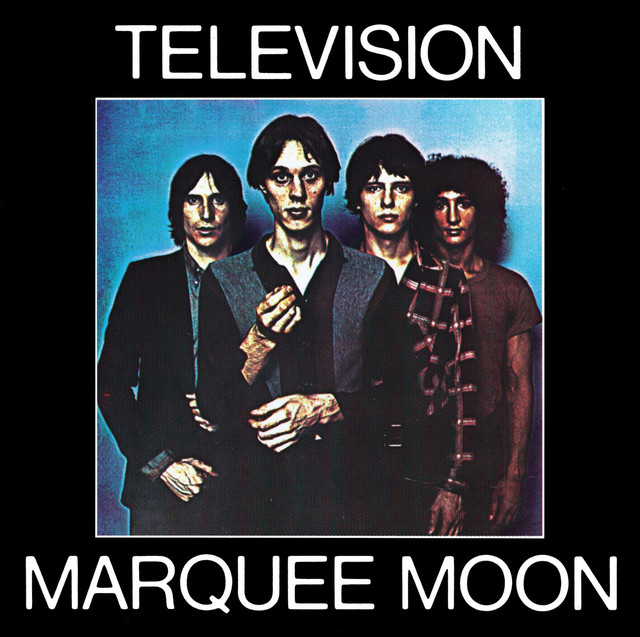
It’s 1977, and New York City’s a glorious wreck—graffiti-smeared subways, flickering streetlights, and a downtown scene where poets, punks, and weirdos collide like atoms in a dive bar. CBGB’s is the epicenter, a grimy cathedral where the Ramones snarl, Blondie slinks, and Patti Smith channels Rimbaud. But on a sweaty spring night, Television takes the stage, and Marquee Moon, their debut album’s title track, rips through the room like a lightning bolt. Ten minutes later, rock ‘n’ roll isn’t the same. It’s not just a song—it’s a seismic event, a secret handshake passed from one obsessed listener to another for nearly half a century.
If you’re new to Marquee Moon, brace yourself. This isn’t punk’s three-chord blitz or disco’s glittery pulse. Tom Verlaine, Television’s lanky frontman, doesn’t so much sing as wail—his voice high, raw, almost whiny, like he’s bleeding truth into a battered mic. It’s not pretty, and that’s the point. “I don’t sing, I feel,” he once said, and you believe him. His lyrics chase big questions—life, death, the ache of uncertainty—against a backdrop of urban decay, all flickering neon and cracked pavement. It’s a search disguised as a song, a transmission from a city that’s falling apart but still dreaming.
The guitars, though? That’s where the magic happens. Verlaine and Richard Lloyd trade clean, chiming riffs that dance like switchblades in a street fight—sharp, precise, but ready to cut. The opening loop is deceptively simple, a hypnotic hook that lodges in your brain like a radio signal from a grittier planet. Then the rhythm section—Fred Smith’s bass and Billy Ficca’s drums—creeps in, weaving muscle into the melody. It’s a slow burn, building from a whisper to a roar, until midway through, the song breaks free. What follows is a sprawling, half-improvised jam, a tightrope walk between chaos and control. It’s the kind of moment that’s nearly extinct today, when bands play it safe and algorithms dictate the groove. Listening now, it’s like unearthing an ancient, still-beating heart under the Bowery’s asphalt.
Television wasn’t supposed to happen. In a scene ruled by punk’s raw fury, they were the oddballs—art-school dropouts with jazz leanings and a poet’s soul. Verlaine, a skinny kid from Delaware, named himself after a French symbolist poet and played like he was channeling Coltrane through a Fender. Lloyd, his foil, brought a melodic edge that made their duets feel like conversations. They weren’t chasing fame; they were chasing something—a sound, a feeling, a glimpse of the infinite. Marquee Moon, released on Elektra in February 1977, was their manifesto, and its title track, clocking in at 10:40, was the centerpiece.
Walk into any record shop in Brooklyn today, and you’ll hear the cult of Marquee Moon still humming. It’s not a song that Spotify shoves in your face or that gets name-dropped in glossy retrospectives. No, this is word-of-mouth music, passed like a joint between fans who get it. At a recent show at Rough Trade, I overheard a 20-something vinyl nerd tell his friend, “It’s like if Dylan and Hendrix had a baby, and that baby grew up in a subway tunnel.” He’s not wrong. The song’s influence echoes through The Strokes’ angular riffs, Sonic Youth’s art-punk sprawl, even R.E.M.’s early jangle. Yet it remains a secret too good to keep.
Why does it endure? Because Marquee Moon doesn’t just play—it speaks. Verlaine’s lyrics, cryptic yet vivid, paint a world of “darkness doubling” and “stars colliding,” a city where dreams and despair share a cigarette. The guitars don’t just riff; they explore, stretching time until you’re lost in the sound. It’s a song that demands you listen, really listen, preferably on a turntable with the volume cranked and the lights low.
So here’s the deal: if you’re tracing punk’s messy roots or New Wave’s jagged birth, Marquee Moon isn’t optional—it’s essential. It’s not background music; it’s a punch to the brain, a song that rewires how you hear rock. Find it, play it, let it haunt you. And when it does, pass it on. That’s how secrets like this survive.