
Oddly enough, it was this song — “Because the Night” — that first pulled me into the sweaty, chaotic, poetry-soaked world of late-’70s New York punk. Not a brash, three-chord thrash-fest, but this: a love song. A haunting, heart-pounding, slow-burn anthem that somehow passes every punk vibe check imaginable.
It’s not just the melody. It’s not just the words. It’s the way Patti Smith fuses rock and roll with raw emotional truth, stitching together poetry and power chords until the lines blur and everything becomes something bigger.
That’s the magic of Patti.
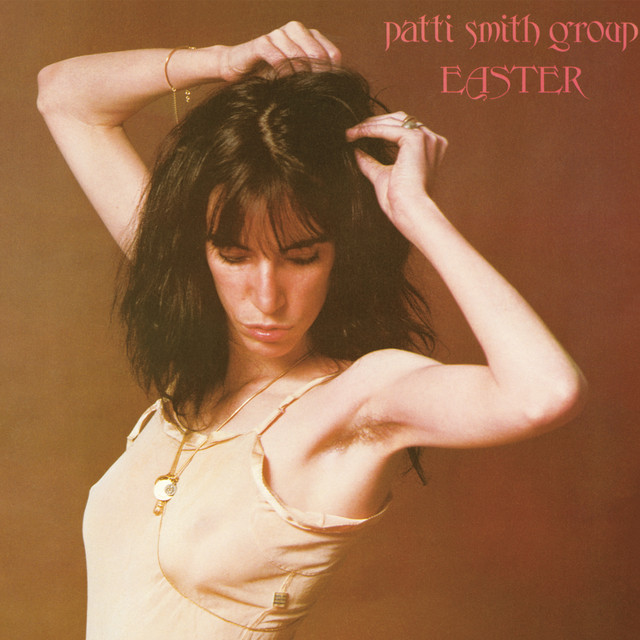
Yes, she was a master of experimentation — just listen to the chaos and spiritual wanderings of Radio Ethiopia (1976), or the sharper, more melodic edges of Easter (1978). But what truly set her apart was how she made spoken-word poetry feel like a natural part of punk’s DNA. At CBGB’s, she’d sometimes just recite her poems live, backed by a band that seemed to hover between jazz, noise, and proto-punk energy. Strange? Maybe. But it worked. And it worked because punk, at its core, has never just been about loud guitars.
That’s the biggest misconception: that punk is just mohawks, moshing, and distortion. But punk has always been about freedom — of thought, of form, of sound. It’s rebellion, yes, but on your own terms. Patti embodied that. She brought the vulnerability of poetry into the rebellion of punk and came out the other side as one of the genre’s high priests.
And nowhere is that fusion more powerful than on “Because the Night.”
Written in collaboration with Bruce Springsteen (yes, that Bruce — more on that in a second), the song is one of the most beautiful declarations of love I’ve ever heard. It’s timeless. It’s romantic without being saccharine, and poetic without being pretentious. It explores love in all its layers — the longing, the want, the raw physical desire — and does it all with Smith’s signature grit.
Production-wise, it’s pure atmosphere. That piano at the start? Soft, a little haunting, like walking alone at night through a city that’s still awake but holding its breath. Then the beat sneaks in during the pre-chorus, slowly building into something anthemic — and when that chorus hits, it explodes. That’s when Patti grabs you by the collar and howls it out:
“Because the night belongs to lovers / Because the night belongs to us.”
And just like that, the song becomes universal. Punk becomes personal. The personal becomes political. Because love, especially expressed this freely and fearlessly, is a kind of revolution.
Here’s the kicker: Bruce Springsteen originally wrote the bones of this song during the Darkness on the Edge of Town sessions. He handed it off to Patti (or let it fall into her hands, depending on who you ask), and she turned it into the roaring, romantic, radio-killer we know today. Springsteen later recorded his own version, which appears on The Promise(2010), and honestly? It slaps too. It’s earthier, maybe more restrained — like a bonfire compared to Patti’s full-on lightning storm. But both versions are worth hearing. Together, they’re two sides of the same coin — one written in New Jersey sweat, the other scrawled in downtown New York fire.
What makes “Because the Night” endure is its refusal to be boxed in. It’s punk, sure — but it’s also poetic, romantic, dramatic, tender. It’s a ballad for people who don’t believe in ballads. A love song for people who’d rather scream their feelings into the night than whisper them across candlelight.
And in a world of fleeting hooks and disposable love songs, Patti Smith’s anthem still hits like a confession shouted from the rooftops.