
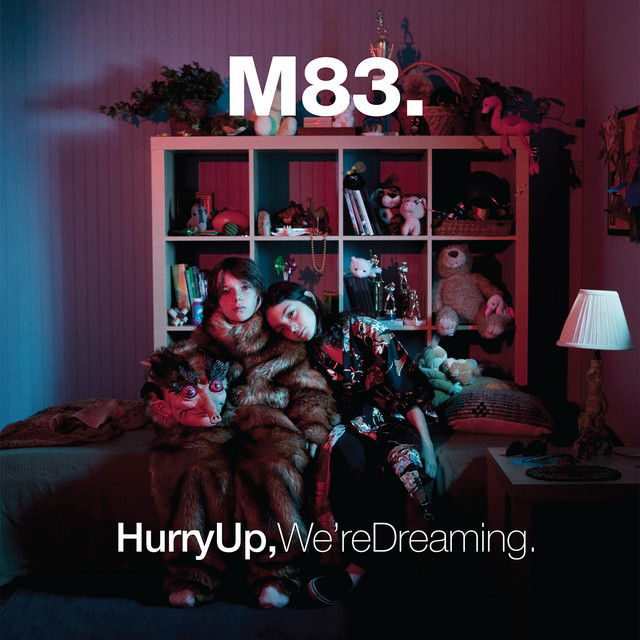
Some songs don’t knock politely—they crash the party uninvited, synths blazing, and suddenly you’re hooked. For me, “Midnight City” by M83 found me that way: no deep dive, no hipster rec. Just social media’s algorithmic roulette, spitting it onto my feed like a cosmic mixtape from a benevolent DJ. One spin through the 2011 double-album Hurry Up, We’re Dreaming, and bam—I was done for. In a world of algorithmic sludge, this track is a reminder: The best stuff still sneaks up and steals your breath.
It starts sneaky. That opening synth squeal—high-pitched, alien, like a spaceship warming up in your headphones—feels awkward, almost comical, tuning in from some parallel dimension. You’re left wondering: Is this a glitch? A drunk uncle attempting karaoke? Then the haze clears. A dreamy melody bubbles under, hazy and hypnotic, before the beat drops at 0:45 like a velvet hammer. Drum machine snap, bass throb, and you’re transported: cruising rain-slicked streets, city lights smearing into streaks of pink and blue. It’s not subtle; it’s massive. Cinematic. The kind of build that makes you grip the wheel tighter, even if you’re just on your couch.
Lyrics? Barely there, like faded graffiti on a warehouse wall: “Waiting in a car / Waiting for a ride in the dark / The night city grows / Look and listen close.” Anthony Gonzalez, the French electronic wizard behind M83, isn’t spinning yarns—he’s painting moods. Co-written with his cousin Yann Gonzalez and producer Justin Meldal-Johnsen, the track channels ‘80s new wave ghosts (think OMD meets Hall & Oates on acid) into a euphoric pulse. But the real MVP? The production. Layer upon layer swells like a tide: shimmering keys, echoing vocals from Morgan Kibby, all cresting in that glorious sax solo. Jordan Lawlor’s riff crashes in at 3:20—not a polite toot, but a beam of golden light, soaring over the synths like a phoenix with a horn section. It’s unexpected, absurdly perfect, turning the song from banger to benchmark.
Hurry Up, We’re Dreaming was M83’s big swing—a sprawling, 80-minute odyssey that peaked at No. 15 on the Billboard 200 and snagged a Grammy nom for Best Alternative Album. “Midnight City” led the charge, hitting No. 1 on Alternative Airplay and infiltrating everything: Euphoria montages, Stranger Things vibes, even car commercials that make you feel like a brooding antihero. Gonzalez crafted it in Los Angeles, chasing that “city at night” thrill, but in 2025? It’s a post-pandemic elixir. We’ve all been “waiting in a car”—Zoom-frozen, scattered by life’s curveballs. Then the drop hits, and it’s reunion time: that magical night when your crew reconvenes, life’s bullshit fades, and suddenly it’s we’re back, baby. Sprinting across a crosswalk at 2 a.m., rooftop cackles echoing, pints clinking under string lights. The city blurs, the joy explodes, and for four minutes, you own the damn world.
That’s “Midnight City”’s sorcery: It’s not just a track; it’s a portal. In our feed-choked era, where nights out compete with Netflix queues, it flips the script on isolation. Gonzalez nailed it in a NME chat: “It’s about those fleeting moments that feel eternal.” TikTok’s flooded with edits—teens lip-syncing the sax in parking lots, Gen Z remixing it with lo-fi beats—proving synthwave’s revival isn’t nostalgia; it’s armor. Bands like The Midnight or FM-84 owe it a royalty check, and hell, even Taylor Swift nodded to its glow on her Midnights tour visuals.
Put it on, and it’s a movie every time: Fade in on the awkward synth hum, cut to the euphoric swell, climax with that sax wail fading into echo. Some songs take you on a journey; “Midnight City” hands you the director’s chair. It turns a solo drive into a memory, a memory into a craving. So crank it. Let the neon wash over you. And next time the universe drops a gem? Say thanks—and hit play.